

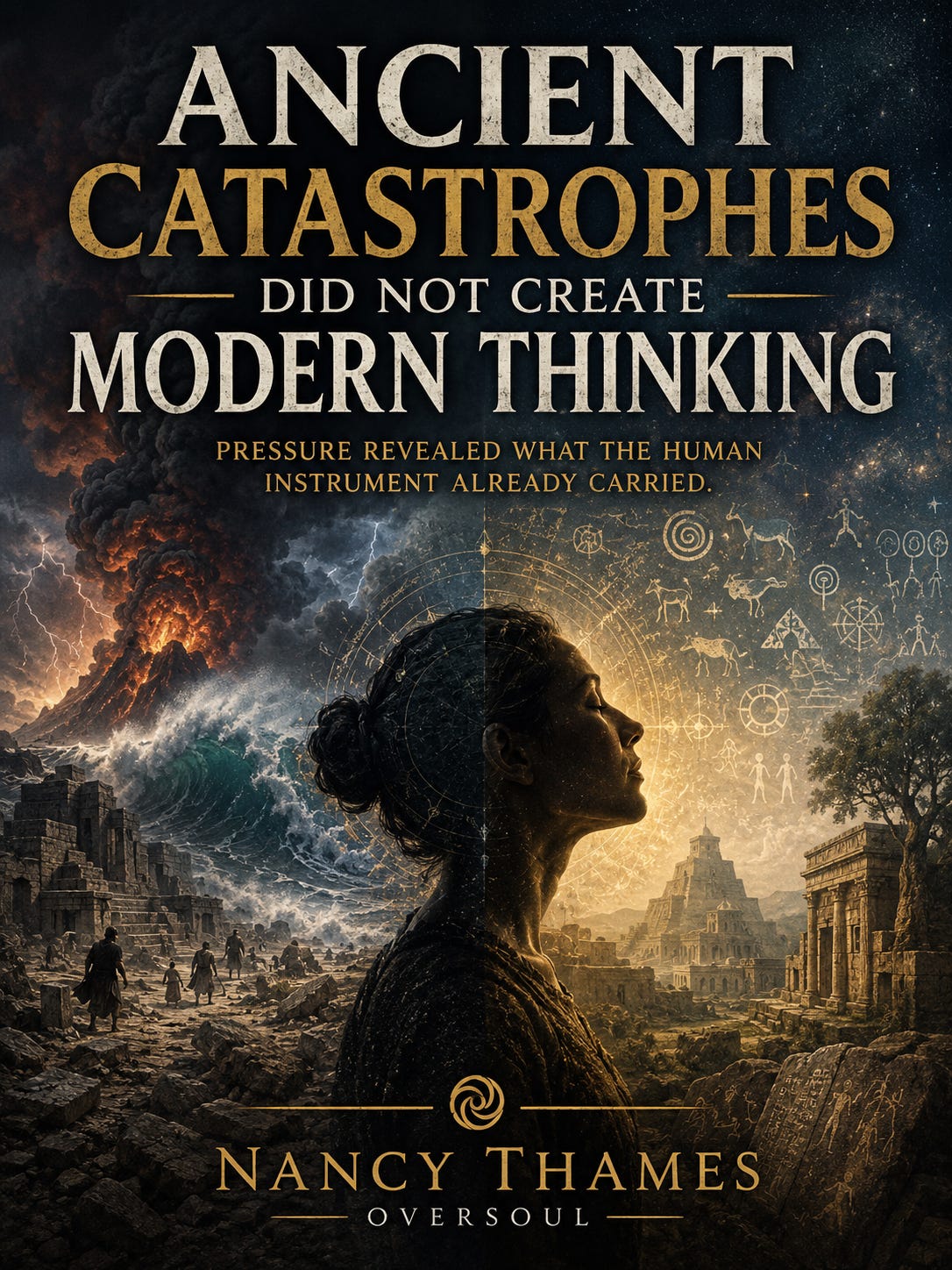
Ancient Catastrophes Did Not Create Modern Thinking
Pressure revealed what the human instrument already carried.

Ancient Catastrophes Did Not Create Modern Thinking
Pressure revealed what the human instrument already carried.
A recurring claim surfaces whenever historians examine the aftermath of major ancient catastrophes: the pressure of survival forced human cognition to develop new capacities it had not possessed before. Planning under scarcity produced foresight. Coordinating disaster response produced early social structure. Grief and loss produced the first abstract thought about mortality and meaning. Catastrophe, in this telling, functions as an evolutionary engine, forcing the mind to build tools it would never have needed under ordinary, stable conditions.
This account gets the direction backward in the same way every historical origin story examined in this series gets the direction backward. Catastrophic pressure did not build new cognitive capacity from nothing. It revealed capacity that was already present, running beneath the surface of ordinary function, requiring conditions extreme enough to force it into visible use. Modern thinking was not created by ancient disaster. It was exposed by it, the way pressure exposes the load a structure was always able to bear but had never been asked to carry.
Why the Creation Story Is Appealing and Wrong
The creation account is appealing because it fits a simple, satisfying logic: hardship produces growth, adversity produces strength, the mind rises to meet what the moment demands. This logic is not entirely false at the level of everyday experience. People do sometimes discover, under pressure, that they are able to do things they did not know they were capable of. The error is not in observing this pattern. The error is in concluding that the capacity was manufactured by the pressure rather than revealed by it.
A capacity that pressure creates from nothing should not persist once the pressure lifts, the same way a tool built for a specific emergency does not remain useful once the emergency ends. But the capacities catastrophe reveals, heightened foresight, coordinated cooperation, abstract reasoning about mortality and meaning, do not disappear once conditions stabilize. They remain part of the operating baseline going forward, passed down, refined, and built upon by generations that never experienced the original pressure directly. This persistence is the tell. Manufactured tools get abandoned once their emergency ends, set aside once the immediate need that justified them has passed. Revealed capacities become permanent instead, because they were never contingent on the emergency in the first place and require nothing further from it to remain in use.
What Extreme Pressure Actually Does to the Instrument
The instrument that filters consciousness into physical experience operates, under ordinary conditions, within a narrower range than it is actually capable of. This is not a design flaw. A narrow operating range under stable conditions is efficient, conserving resources that would otherwise go toward processing information the environment does not currently require. Extreme pressure changes the calculation. When ordinary stability collapses, the narrow range calibrated for stable conditions no longer matches what the environment demands, and the instrument’s capacity to operate across a wider range, capacity that was present the entire time but unused, becomes active.
This is a materially different claim than simply saying catastrophe builds new capacity. It is a claim about activation, not manufacture. The wider range was always available, the same way a muscle’s full strength is available before any specific circumstance calls on the body to use all of it at once. Catastrophic pressure does not install foresight, cooperation, or abstract reasoning about mortality into an instrument that previously lacked them. It removes the conditions under which a narrower operating range was sufficient, and the instrument’s fuller range, present but dormant, becomes the range actually in use.
Why This Matters for Reading the Archaeological Record
The archaeological record following major ancient catastrophes contains examples that fit this pattern more closely than a simple manufacture model predicts. Sophisticated symbolic behavior, elaborate burial practices, coordinated large scale construction, complex social organization, these markers appear with a suddenness in the record that a slow, gradual, catastrophe built capacity should not produce. If pressure were manufacturing new cognitive tools from scratch, the record should show gradual accumulation, incremental improvement across many generations as each new tool gets built and refined. What the record actually shows, at multiple points following documented catastrophic events across separate regions and time periods, is abrupt appearance, capacities showing up essentially complete rather than assembled piece by piece under duress.
Abrupt appearance is the signature of revealed capacity, not manufactured capacity. A population whose instrument was already capable of sophisticated symbolic behavior, coordinated planning, and abstract reasoning, operating under conditions that had not previously required the full expression of that capacity, will show exactly this pattern once conditions change enough to call the fuller range into active use. The capacity did not need to be built because it was never absent. It only needed pressure sufficient to make it visible in behavior the archaeological record can detect.
What Gets Lost When Catastrophe Is Treated as the Origin
Treating catastrophe as the origin point of modern thinking produces the same distortion this series has already identified in other contexts: a historical event gets credited with creating something that was present at every point along the timeline, simply less visible before the event than after it. This distortion has a specific, ongoing cost. It frames the capacities in question, foresight, cooperation, abstract reasoning, as fragile achievements won through suffering, owed to catastrophe, and by implication dependent on catastrophe or catastrophe like pressure to remain active and available.
This framing has consequences beyond historical accuracy. A population that believes its own capacity for sophisticated thought was manufactured by ancestral suffering will tend to treat continued access to that capacity as something that requires ongoing pressure to sustain, an assumption with no support once the mechanism is understood correctly. The capacity was never a product of the suffering. It was always present in the instrument, and the suffering only supplied conditions extreme enough to force its expression into visible use. Removing the pressure does not remove the underlying capacity. It only removes the specific conditions that once made that capacity necessary to express at full range.
Why Individual Crisis Shows the Same Pattern at Smaller Scale
The same mechanism that operates at the scale of ancient planetary catastrophe operates identically at the scale of an individual life facing acute personal crisis. People consistently report clarity, insight, and capability during crisis that they did not know they had access to beforehand, the same pattern the archaeological record shows at civilizational scale. The standard interpretation treats this as the crisis forging something new in the person, a kind of trial by fire that builds character or capacity that did not exist before the trial began.
The more accurate reading, consistent with everything already established in this series about pressure and reception, is that acute personal crisis operates on an individual instrument exactly the way planetary catastrophe operated on ancient populations. It does not build new capacity. It removes the narrow operating range that ordinary stable conditions made sufficient, and the instrument’s fuller capacity, present the entire time, becomes active. This is why people frequently describe crisis clarity as feeling like something recovered or uncovered rather than something newly constructed. That description is accurate. It is recovery of range, not construction of capacity.
What Predicts Which Populations Revealed More
If catastrophe reveals rather than creates capacity, a specific prediction follows: populations facing comparable catastrophic pressure should not show uniform gains in cognitive and social sophistication, because revealed capacity depends on what was already present in the instrument, not on the pressure alone. This is precisely the pattern the record shows. Some populations facing severe environmental catastrophe collapsed, contracted, and left behind evidence of simplified social structure rather than expanded sophistication. Others facing comparable pressure show the opposite, rapid gains in symbolic complexity, coordination, and abstract reasoning.
A pure manufacturing model, where pressure builds new capacity directly, struggles to explain this variation, since comparable pressure should produce comparable results if the pressure itself is doing the building. A revelation model handles the variation without strain. Pressure exposes whatever range was already available in a given population’s instrument. Where that range was substantial, pressure reveals substantial capacity. Where circumstances had left less range available, or where the pressure exceeded what any available range was able to sustain, the same catastrophic conditions produce contraction instead of revelation. The outcome tracks the instrument’s prior capacity, not simply the severity of what it faced.
Why the Instrument Does Not Fully Retract Afterward
A further detail supports the revelation model over the manufacturing model. If catastrophe built new cognitive tools purely to meet an emergency, those tools should have limited persistence once the emergency passes, the way specialized emergency equipment gets decommissioned once the crisis it was built for ends. Instead, the sophistication that appears following ancient catastrophic pressure persists, gets built upon, and becomes the baseline for everything that follows, even many generations removed from anyone who experienced the original pressure directly.
This persistence only makes sense if what appeared was never contingent on the emergency to begin with. A capacity manufactured specifically to meet a vanished emergency has no obvious reason to remain useful once that emergency is gone. A capacity that was always part of the instrument’s available range, merely activated by conditions severe enough to require it, has every reason to remain in use once activated, because using it does not depend on the original conditions continuing. The descendants of populations that revealed sophisticated capacity under ancient pressure inherited an instrument with that range already demonstrated as accessible, not a tool built for a threat that no longer exists.
Why This Reframe Changes What Modern Thinking Actually Is
If modern thinking was revealed by catastrophe rather than created by it, then modern thinking was never a historical achievement locked to a particular set of ancient conditions that no longer exist. It was, and remains, a standing capacity of the instrument, available at full range whenever conditions call for it, regardless of era. This has a direct and immediate implication for how the capacity for sophisticated thought should be understood today. It is not a fragile inheritance passed down from ancestors who earned it through suffering and now must be carefully protected lest it be lost. It is a baseline capability of the instrument itself, narrowed under ordinary stable conditions for efficiency, and available in full whenever circumstances remove the conditions that made the narrower range sufficient.
This reframing does not diminish what ancient populations lived through, and it does not suggest catastrophic pressure is a desirable or necessary condition for accessing full capacity. It simply corrects the underlying causal claim. The pressure endured was real. The suffering endured was real. What it produced, however, was not new capacity built from nothing, but the forced activation of a range the instrument had carried all along, waiting on conditions extreme enough to require its use. Modern thinking is not humanity’s reward for having survived catastrophe. It is what the instrument was always capable of, made visible by circumstances severe enough to finally call on the whole of it at once, whether that pressure arrived at the scale of a civilization or the scale of a single life facing something it never expected to survive.
This distinction has a practical implication worth stating directly, one that reaches well beyond the historical question this article opened with. If sophisticated thought were genuinely manufactured by ancestral hardship, access to it would reasonably depend on ongoing hardship to sustain, an unstated assumption behind a great deal of thinking about resilience, character, and what suffering supposedly builds in a person. Once the mechanism is understood as revelation rather than manufacture, that dependency dissolves. The range was never conditional on the suffering that first revealed it. It is conditional only on whatever circumstance calls it into use, and comfort does not remove a capacity that comfort never installed in the first place. It only leaves that capacity, for the moment, unused.
substack.com/@nancythames medium.com/@nbt088 ko-fi.com/nancythames Nancy Thames – Oversoul catastrophe, cognition, consciousness, ancient disasters, reception range ancient-catastrophes-did-not-create-modern-thinking
I’m not disputing your general thesis, but the period following the collapse of Bronze Age civilization after 1200 BC was a time of social simplification but also an era of sages and prophets that led directly into a brilliant cultural explosion after 800 BC. Both things can go together.