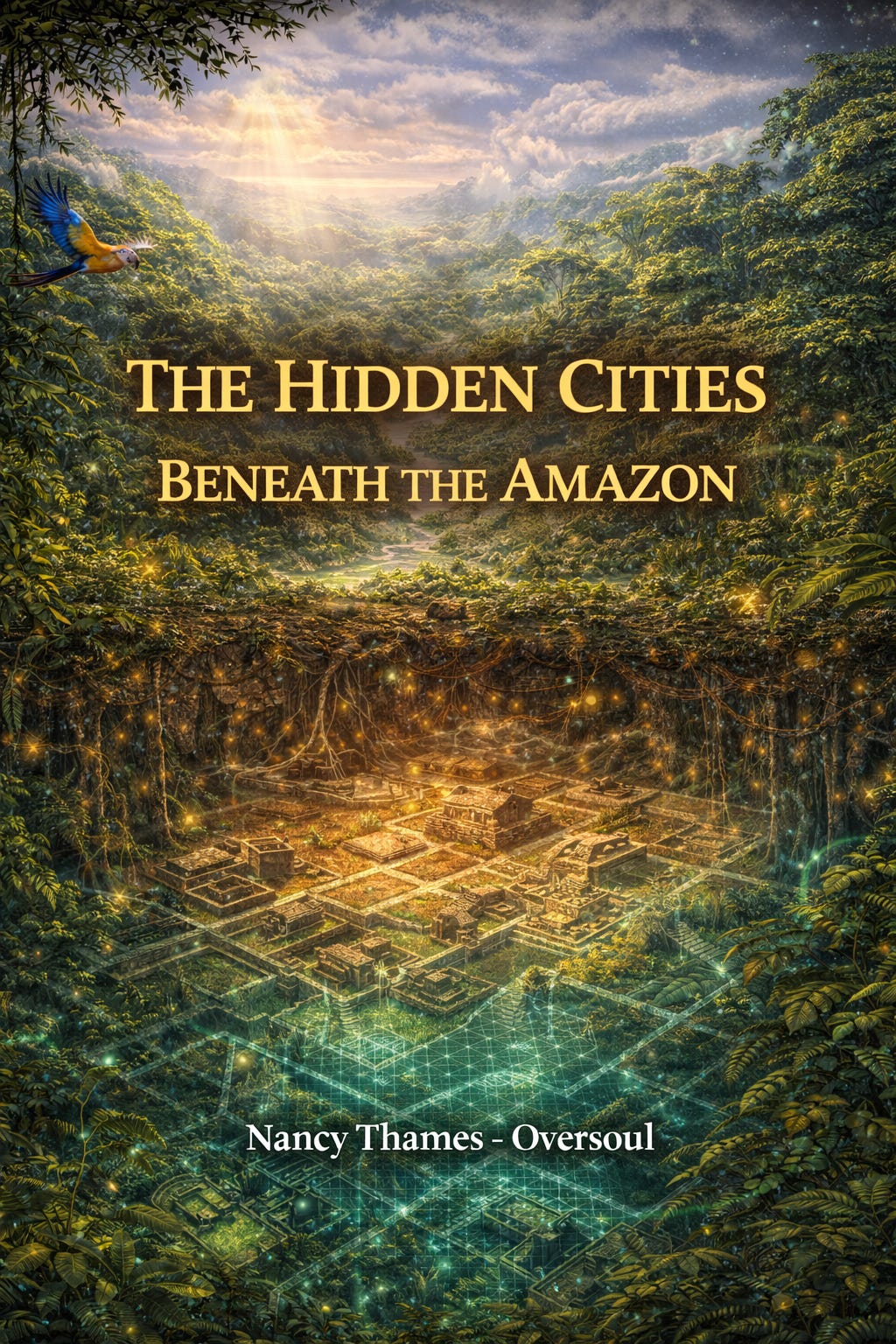
The Hidden Cities Beneath the Amazon

The Hidden Cities Beneath the Amazon
For centuries the rainforest concealed the remains of civilizations that history never recorded.
For most of modern history, the Amazon rainforest was described as one of the last untouched wilderness regions on Earth. Early explorers who traveled through the basin wrote about endless forest stretching across the horizon, broken only by rivers and scattered tribal communities living within the dense vegetation.
The assumption became widely accepted.
The Amazon had always been wild.
Civilization had never truly lived there.
But the forest was hiding something.
Beneath the canopy of the Amazon lie the remains of societies that existed long before historians realized they were there. Roads, settlements, agricultural systems, ceremonial earthworks, and engineered landscapes have now been discovered across large portions of the basin.
For centuries the rainforest quietly erased the evidence.
Only recently has modern technology begun revealing what the jungle concealed.
The breakthrough came with the development of aerial scanning technologies, particularly LiDAR. This system sends pulses of laser light toward the ground from aircraft. By measuring how those pulses reflect back, scientists can digitally remove the visual layer of vegetation and reveal the terrain hidden beneath the forest canopy.
When researchers first applied LiDAR to sections of the Amazon basin, the results were astonishing.
Entire landscapes shaped by human hands appeared beneath the trees.
Large geometric earthworks emerged from the data. Perfect circles, squares, and long straight trenches stretched across the land in patterns that could only have been created by organized societies. Some of these shapes extended hundreds of meters across the landscape.
They were invisible from the ground.
But from above, they formed enormous patterns embedded in the earth.
These earthworks were not isolated structures.
Networks of raised roads connected distant settlements. Large platforms appeared that likely served as ceremonial centers or communal gathering spaces. Agricultural landscapes revealed carefully engineered systems designed to manage seasonal flooding and improve soil fertility.
These discoveries made something clear.
The Amazon had once supported far larger human populations than historians believed possible.
In several regions across Bolivia, Brazil, Peru, and other parts of the basin, entire networks of settlements connected by roads and canals have now been identified.
One of the most remarkable discoveries occurred in the Llanos de Mojos region of Bolivia. There researchers uncovered the remains of a civilization now known as the Casarabe culture.
LiDAR scans revealed large urban centers surrounded by smaller communities connected through straight causeways that stretched across the floodplain. Some of these settlements contained monumental platforms rising several meters above the surrounding landscape.
The region also contained sophisticated water management systems.
Raised agricultural fields allowed crops to grow above seasonal floodwaters. Canals directed water across the terrain, helping regulate flooding and irrigation. Reservoirs stored water during dry periods.
The entire landscape had been engineered.
These societies were not merely surviving in the rainforest.
They were shaping it.
The discoveries suggest that large populations once lived within the Amazon basin in organized communities that thrived for centuries. Trade routes likely connected settlements across large distances. Agricultural systems supported stable food supplies. Social structures coordinated labor to build roads, canals, and ceremonial structures.
The Amazon had once contained cities.
Yet by the time European explorers entered the basin in the sixteenth century, many of these societies had already vanished.
Disease played a devastating role in this transformation. European illnesses such as smallpox, measles, and influenza spread rapidly through indigenous populations long before explorers reached many regions directly.
These diseases moved through trade networks between communities.
Entire populations collapsed within generations.
Without the people maintaining agricultural fields, roads, and settlements, the rainforest began reclaiming the landscape.
Plants colonized abandoned farmland.
Roots broke apart roads and earthen structures.
Trees rose through plazas where communities had once gathered.
Within decades the transformation began.
Within centuries entire cities disappeared beneath the forest.
Unlike deserts where ruins remain visible for thousands of years, the Amazon recycles nearly everything back into living soil. Buildings constructed from earth and wood dissolve quickly in the humid environment. Vegetation grows rapidly over abandoned ground.
The rainforest absorbs human structures.
It converts them into nutrients.
Civilizations vanish.
The forest continues growing.
Because of this process, the Amazon became one of the most effective erasers of human history on Earth.
Societies could flourish for centuries and leave almost no visible trace within a few generations after they disappeared.
Only subtle patterns in the soil remained.
Those patterns were invisible until modern technology allowed researchers to see through the forest canopy.
Even the soil itself reveals evidence of these earlier civilizations.
Across the Amazon basin archaeologists discovered patches of unusually fertile soil known as terra preta, meaning “black earth.” This soil was deliberately created by ancient inhabitants who mixed charcoal, organic waste, food remains, and biological material into the ground.
Unlike the surrounding rainforest soil, terra preta remains fertile for centuries.
These engineered soils allowed agriculture to flourish in an environment where natural soil fertility is often low. Some areas of terra preta extend across several square kilometers, indicating long-term settlement and sustained agricultural activity.
These discoveries reveal something important about how ancient Amazonian societies interacted with the ecosystem.
They were not attempting to conquer the rainforest.
They were learning how to cooperate with it.
Instead of clearing enormous areas of forest, they shaped landscapes gradually. Agriculture blended into the surrounding ecosystem rather than replacing it entirely. Communities existed within the forest rather than attempting to dominate it.
The rainforest and the civilization functioned together.
When those civilizations declined, the forest simply continued its biological cycles.
Plants reclaimed abandoned fields.
Roots dismantled roads.
Structures dissolved into soil.
The ecosystem absorbed the remains of human activity and transformed them into the next generation of life.
From an Oversoul perspective, the hidden cities beneath the Amazon reveal the difference between human time and planetary time.
Civilizations often measure their existence in centuries.
Planetary ecosystems operate across thousands or millions of years.
Human societies may appear dominant during their moment in history, but they exist within much larger natural systems that continue operating regardless of human success or failure.
The rainforest does not preserve monuments the way deserts do.
It transforms them.
Stone becomes soil.
Wood becomes nutrients.
Cities become forest.
The jungle does not intentionally erase history.
It simply continues the processes of life.
And in doing so, it quietly absorbs the remains of entire civilizations beneath its canopy.
If this line of thought resonates, I continue writing beyond this space here.
Subscribe for ongoing Codex writings:
https://substack.com/@nancythames
Amazon rainforest, lost civilizations, lidar discoveries, terra preta, ancient societies, oversoul consciousness
Nancy Thames – Oversoul