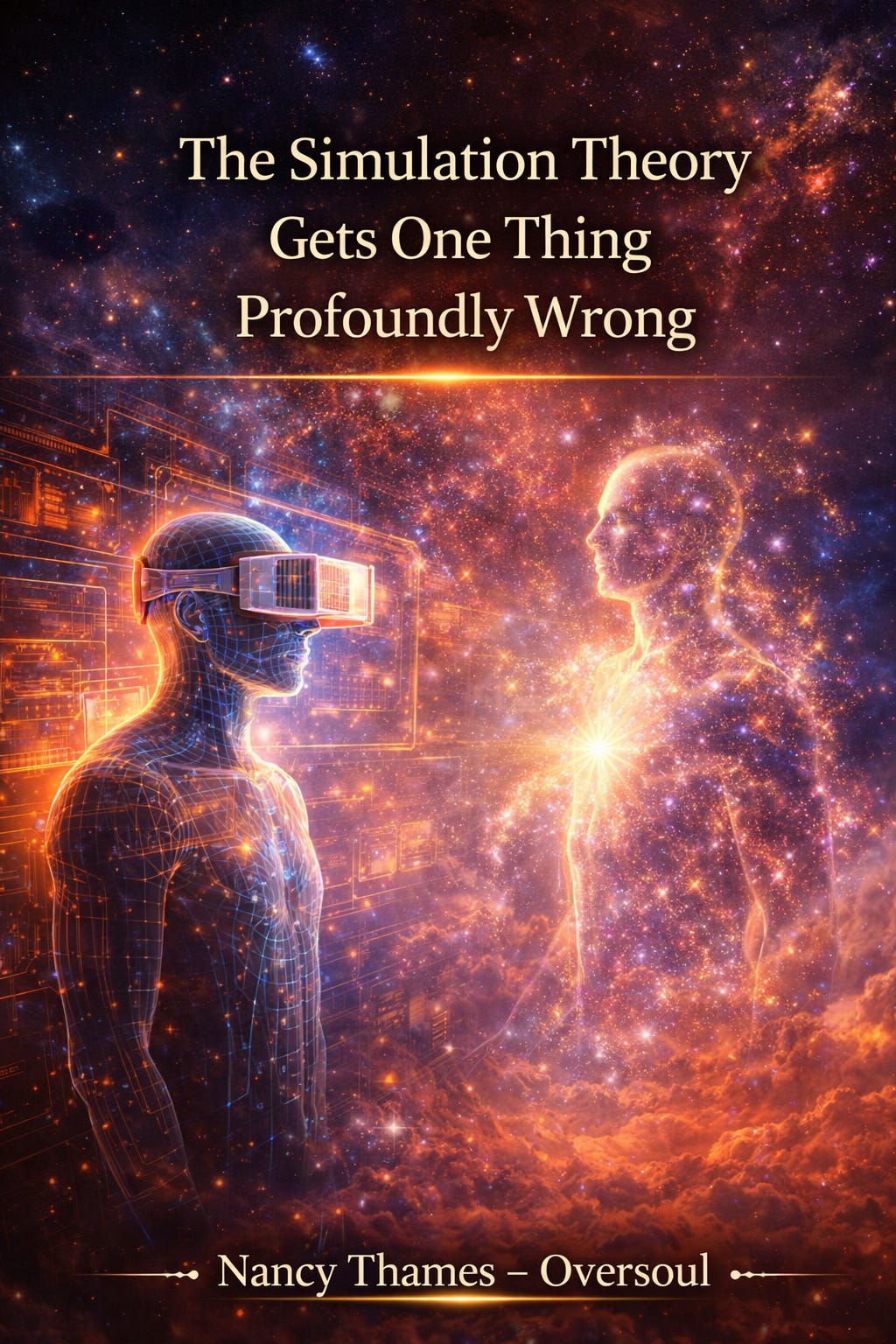
The Simulation Theory Gets One Thing Profoundly Wrong

The Simulation Theory Gets One Thing Profoundly Wrong
Oversoul truth about reality, perception, and why the error is not in the idea but in where it places you
The simulation theory gets one thing profoundly wrong.
Not in its observation.
In its conclusion.
The observation is clear. Reality does not behave as something fixed. It responds, it shifts, it organizes itself in ways that are not entirely predictable, and it does not present itself as a fully objective, independent structure separate from the observer.
That part is correct.
What is incorrect is the assumption that because reality behaves this way, it must be artificial in the sense of being constructed by something outside of you.
This is the leap.
And it is the mistake.
Simulation theory places the source of reality elsewhere. It assumes that if what you experience is not fundamental, then something else must be generating it from a higher level, something external, something separate.
But the error is not recognizing responsiveness.
It is misplacing origin.
Reality is not being projected at you.
It is being processed through you.
This is the distinction that changes everything.
The idea of simulation creates distance. It positions you as a participant inside a system that is being run. It implies control exists outside of your reach, that what you are experiencing is ultimately dependent on something you are not.
This reinforces separation.
It stabilizes the same structure that prevents direct recognition.
Because if reality is being generated elsewhere, then you are always secondary to it.
Always inside it.
Never part of its formation.
But this is not what is happening.
What you experience as reality is not a pre-rendered environment waiting for you to enter it. It is not a fixed construct being delivered to your perception. It is a dynamic interaction between what is present and how it is being processed.
This is why perception matters.
Not as interpretation.
As function.
The mind does not passively receive reality.
It organizes it.
Filters it.
Stabilizes it into a form that can be navigated.
This is not illusion.
It is compression.
Without compression, there would be no continuity, no stability, no ability to interact within a shared framework.
But compression removes detail.
It reduces complexity.
It presents a version that can be managed.
This is what you experience.
Not the full structure.
The processed one.
Simulation theory identifies the processing.
But misidentifies the source.
It assumes that because you are not seeing everything, what you are seeing must be artificially generated.
But limitation of perception does not imply artificial origin.
It implies filtering.
The same way a screen does not create what it displays, it renders a version of something that is being translated into a form you can perceive.
But in this case, the screen is not separate from you.
It is you.
This is where the shift occurs.
You are not inside the simulation.
You are part of the system that produces the experience.
Not individually.
Structurally.
This does not mean you control it in the way people attempt to frame it. It does not mean you can alter reality at will or override the conditions of the system.
It means you are not separate from its formation.
And separation is the core assumption simulation theory reinforces.
The idea of being inside something creates hierarchy.
It creates levels.
It places authority outside of direct experience.
But what is actually happening does not require that structure.
Reality is not layered in the way it is often described.
It is integrated.
What appears as layers is difference in access.
Difference in perception.
Difference in how much of the structure is being processed at once.
This is why certain experiences feel more “real” than others. Not because they are closer to a base layer, but because the filtering is different.
Less compression.
More direct access.
But even those experiences are still processed.
Still structured.
Still limited in what can be held at once.
This is not a flaw.
It is a function.
Without limitation, there is no experience.
Without filtering, there is no distinction.
Without distinction, there is no interaction.
So the system is not designed to hide reality from you.
It is designed to allow you to experience it at all.
This is where simulation theory inverts the structure. It assumes that limitation is evidence of deception.
It is not.
It is evidence of interface.
The same way an interface allows interaction with something too complex to engage directly, perception allows interaction with a system that cannot be fully processed at once.
But interface is not the same as simulation.
Simulation implies separation between what is real and what is experienced.
Interface implies translation.
What you experience is real.
It is not complete.
But incompleteness does not make it artificial.
It makes it accessible.
This is why searching for the “base reality” becomes a loop. It assumes there is a final layer that is more real than the one you are in.
But what you are in is not a layer.
It is a perspective.
And perspective can shift.
Not by leaving the system.
By changing how it is processed.
This is where people begin to approach the edge of what simulation theory is trying to describe. They recognize that reality responds differently depending on state, perception, and awareness.
But instead of recognizing this as interaction within the system, it is interpreted as evidence of a constructed environment.
This is the misread.
Responsiveness does not require an external controller.
It requires a system that is not separate from what is perceiving it.
You are not inside something being run.
You are within something being experienced through structure.
This is why the question is not “who built the simulation.”
The question is “what is being filtered.”
Because what is filtered determines what is experienced.
And what is experienced determines what is assumed to be real.
Simulation theory is not wrong.
It is incomplete.
It identifies the processing.
But it externalizes the source.
And in doing so, it reinforces the very separation that prevents direct recognition.
Reality is not happening to you.
It is happening through you.
Not individually.
As part of the system itself.
This is what changes the entire framework.
You are not inside the simulation.
You are part of the interface.
And what you are interfacing with is not separate from what you are.
If this line of thought resonates, I continue writing beyond this space here.
Subscribe for ongoing Codex writings:
https://substack.com/@nancythames
Nancy Thames – Oversoul