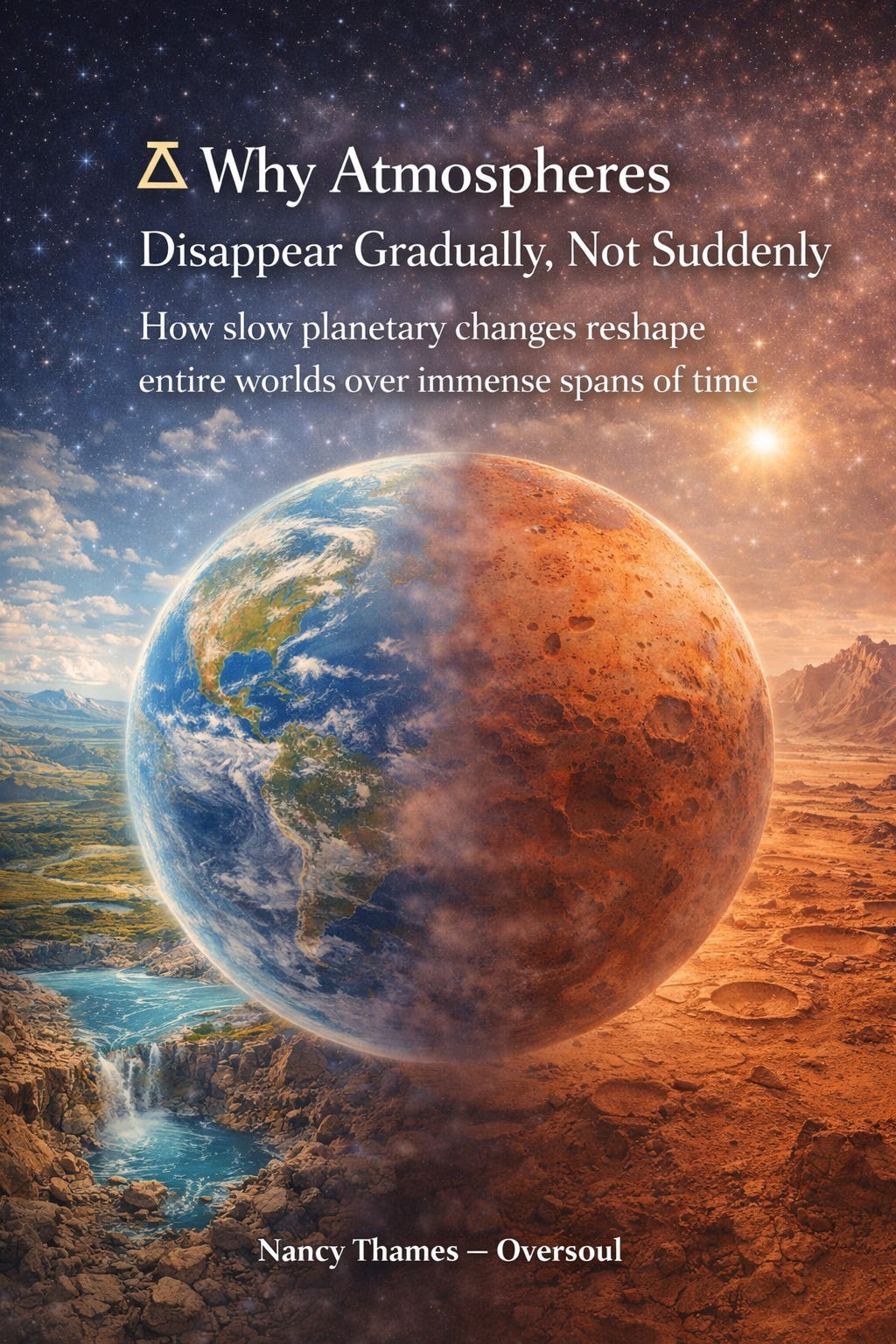
🜏 Why Atmospheres Disappear Gradually, Not Suddenly

🜏 Why Atmospheres Disappear Gradually, Not Suddenly
How slow planetary changes reshape entire worlds over immense spans of time
When people imagine a planet losing its atmosphere, they often picture a sudden catastrophe, a violent event that strips the air away in a short period. This image is dramatic and easy to imagine, but it does not reflect how planets usually change. In reality, atmospheres are lost slowly. The process unfolds over immense spans of time, so gradually that no single moment marks the change. Yet over millions and billions of years, the result can transform an entire world.
An atmosphere is not a fixed shell. It is a dynamic system constantly interacting with space, sunlight, the surface, and the interior of a planet. Gases rise, cool, react chemically, and sometimes escape into space. At the same time, new gases can be released from volcanic activity or chemical reactions within the crust. As long as these gains and losses remain balanced, the atmosphere persists. When the balance shifts, gradual change begins.
One of the most important factors in atmospheric retention is gravity. A planet must be massive enough to hold lighter gases over long periods. Smaller worlds have weaker gravity, and their atmospheres escape more easily. This loss is not sudden. Individual molecules gain enough energy to escape the planet’s pull, and over immense spans of time, enough molecules are lost to thin the atmosphere noticeably.
Temperature also plays a role. Warmer gases move faster, and faster molecules escape more easily. When a planet cannot regulate temperature effectively, the upper atmosphere becomes more vulnerable to gradual loss. Sunlight and radiation contribute energy to atmospheric particles, increasing the likelihood that some will drift into space.
Magnetic protection is another key factor. A magnetic field helps shield the atmosphere from streams of charged particles flowing outward from a star. Without this protection, the upper layers of the atmosphere are slowly eroded. This process does not occur in a single event. It unfolds particle by particle, day after day, for millions of years.
Mars illustrates this process clearly. Early in its history, the planet had a thicker atmosphere and stable surface water. As its interior cooled, the magnetic field weakened and eventually disappeared. Without that protection, solar wind gradually removed atmospheric particles. Pressure decreased slowly, and over immense spans of time, water at the surface became less stable. Rivers stopped flowing, lakes vanished, and the environment changed step by step rather than all at once.
Volcanic activity also influences atmospheric change. Active interiors release gases that replenish what is lost. When internal activity declines, this replenishment weakens. The atmosphere then begins to thin because losses continue while gains diminish. This imbalance may be small at first, but over long periods it becomes significant.
Chemical reactions further alter atmospheric composition. Gases can bind with minerals in the soil or dissolve in water, gradually removing them from the air. On Earth, oxygen remains abundant because living systems continually replenish it. Without that replenishment, oxygen would slowly react with rocks and diminish. This demonstrates how atmospheric balance depends on ongoing processes rather than a single condition.
Time is the factor that makes these slow processes powerful. Changes that are almost invisible within a human lifetime accumulate over millions of years. A slight decrease in atmospheric density becomes a significant thinning. A small change in temperature becomes a shift in climate. The disappearance of stable surface water becomes a permanent transformation of the landscape.
This gradual change explains why many planets show evidence of earlier environments very different from those seen today. River valleys, sediment layers, and mineral deposits reveal conditions that existed long before the present state. These features are records of transitions that unfolded slowly, not the aftermath of sudden destruction.
Earth retains its atmosphere because several stabilizing processes continue to operate together. The magnetic field shields the upper atmosphere. Oceans and living systems help regulate atmospheric composition. Geological activity releases gases that replenish losses. These interacting processes maintain balance, allowing the atmosphere to persist over immense spans of time.
Understanding how atmospheres disappear changes the way we think about planetary evolution. A world does not usually transform overnight. It shifts gradually as internal activity declines, protective systems weaken, and environmental cycles fade. The result may appear dramatic when viewed across geological time, but each step of the process is slow and continuous.
This perspective also changes how we see quiet worlds. A thin atmosphere is not the sign of a single event but the outcome of countless small changes accumulated over immense spans of time. The present state of a planet is therefore a record of its history, shaped by processes that operated patiently and persistently.
Mars stands as one of the clearest examples of this principle. Its thin atmosphere and dry surface are not the result of sudden loss but of gradual change. The planet did not transform in a moment. It changed step by step as the balance that once sustained its atmosphere slowly shifted.
Nancy Thames – Oversoul
If this line of thought resonates, I continue writing beyond this space here.
https://nancythames.substack.com
https://medium.com/@nbt088
Mars, atmospheres, planetary evolution, atmospheric loss, environmental change, planetary science, long term stability, Oversoul