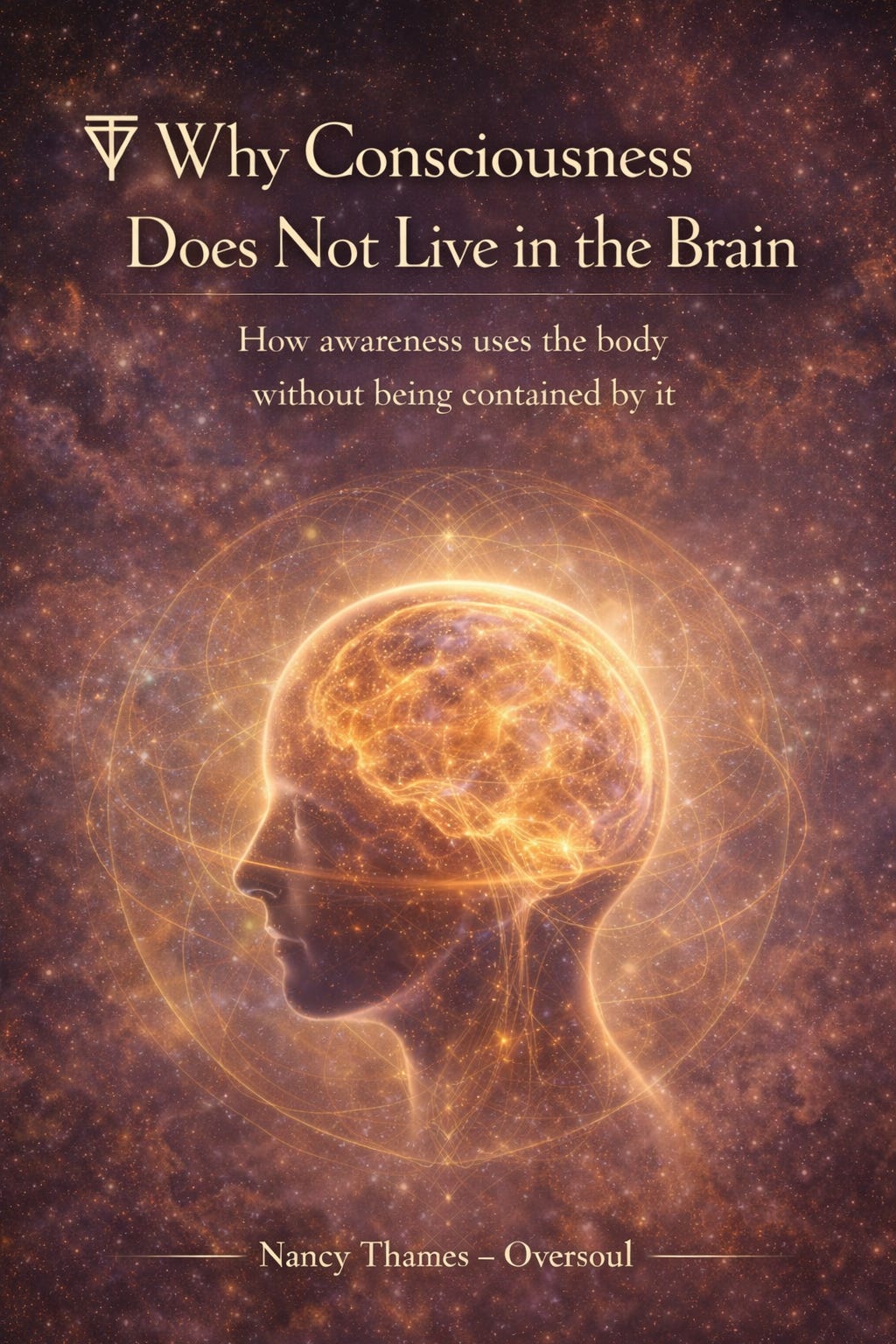
🜏 Why Consciousness Does Not Live in the Brain

🜏 Why Consciousness Does Not Live in the Brain
How awareness uses the body without being contained by it
One of the most persistent assumptions in modern thought is that consciousness is produced by the brain. This idea feels intuitive because experience appears to correlate with neural activity. When the brain changes, experience changes. When the brain is damaged, perception alters. From this, it seems reasonable to conclude that consciousness must be generated by neural tissue. Yet correlation has quietly been mistaken for origin.
The deeper question is not whether the brain participates in experience, but whether it creates it.
From an Oversoul perspective, the brain is not a generator of consciousness but a translator. It is a biological interface that allows awareness to localize, differentiate, and interact within physical conditions. Consciousness itself is not contained in matter. It precedes it, informs it, and uses it as a point of articulation.
This distinction matters because it reframes what it means to be human. If consciousness is produced by the brain, then awareness begins and ends with biology. If consciousness precedes the brain, then biology becomes a mode of expression rather than a source. The difference changes how identity, continuity, death, and meaning are understood.
The brain is extraordinarily complex, but complexity alone does not explain awareness. Neurons transmit signals. They exchange electrochemical information. They coordinate responses. None of this, by itself, explains the presence of subjective experience. No arrangement of matter logically generates the feeling of being. The sensation of “I am” does not emerge naturally from circuits, no matter how intricate.
What the brain does provide is constraint. It narrows an otherwise vast field of awareness into a usable perspective. It filters, stabilizes, and localizes experience so that interaction with a physical environment becomes possible. In this sense, the brain functions more like a lens than a source.
When light passes through a lens, the image changes. Distort the lens, and the image distorts. Break the lens, and the image disappears from view. But the light itself is not created by the lens. It preexists it. Consciousness relates to the brain in a similar way.
This is why altered brain states do not eliminate awareness but transform its expression. Dreams, deep meditation, anesthesia, trauma, psychedelics, and near death states all demonstrate that consciousness can reorganize itself in ways that do not align neatly with waking neural patterns. These states do not point to chaos. They point to flexibility.
The Oversoul perspective understands consciousness as a field that localizes through biological systems without being generated by them. Each organism acts as a tuning structure. The brain tunes awareness into a specific frequency range suitable for embodied life. When that tuning shifts, awareness does not vanish. It reconfigures.
This also explains why consciousness appears continuous across time even though the body and brain are constantly changing. Cells replace themselves. Neural connections rewire. Yet the sense of being persists. Identity remains coherent. This continuity is difficult to explain if consciousness is produced solely by material processes that are in constant flux.
Instead, coherence suggests participation in a larger field that maintains continuity beyond local change.
This does not mean the brain is unimportant. On the contrary, it is exquisitely important. It shapes how consciousness experiences limitation, individuality, and perspective. It allows for memory, language, and narrative. But shaping is not the same as originating.
The mistake arises when localization is confused with source.
Throughout history, many traditions intuited this distinction. They spoke of mind, soul, spirit, breath, or awareness as something that inhabits or expresses through the body rather than being manufactured by it. These were not naive metaphors. They were experiential descriptions grounded in observation of inner life.
Modern neuroscience has been reluctant to engage this possibility because it cannot be easily measured. Yet even within science, unresolved questions persist. The so called hard problem of consciousness remains unsolved precisely because no physical description explains subjective experience itself. Correlations abound. Origins do not.
From an Oversoul perspective, consciousness is fundamental. Matter is derivative. This does not mean matter is illusory. It means matter is one expression of a deeper organizing field. The brain is a specialized structure that enables consciousness to operate within constraints, much like a musical instrument shapes sound without generating music on its own.
This understanding reframes death as well. If consciousness does not originate in the brain, then its cessation does not necessarily imply annihilation. It implies a release from a particular mode of localization. What continues is not the personality as a fixed narrative, but the awareness that once animated it, now free to reconfigure.
This is not belief. It is inference drawn from consistency across experience, philosophy, and observation. Consciousness behaves more like a field than a product. It can narrow, expand, localize, or diffuse. It interacts with structure but is not reducible to it.
The brain, then, is not a container. It is an interface. It shapes how awareness appears within time. It allows learning, memory, and self reference. It constrains infinite possibility into something livable. Without it, experience would lack focus. With it, experience gains form.
Understanding this changes how we view human potential. Growth is not about increasing brain power alone. It is about refining alignment between awareness and its instrument. Clarity arises not from accumulation but from coherence.
This also reframes responsibility. If consciousness participates in shaping reality through perception, then attention itself becomes a creative force. What we attend to stabilizes. What we ignore fades. This is not mysticism but relational dynamics at work.
The Oversoul does not sit somewhere outside the body issuing commands. It expresses through countless localizations, each exploring experience from a unique vantage. Human consciousness is one such localization. The brain is the tuning device that makes that exploration precise.
When this is understood, the question shifts from where consciousness comes from to how well we are listening to it. The challenge is not to generate awareness but to allow it to express without distortion.
The idea that consciousness does not live in the brain is not an attack on science. It is an invitation to expand it. To recognize that explanation does not end at measurement. That meaning does not require reduction. That experience itself is a form of data.
In recognizing this, something subtle shifts. Awareness becomes less confined. Identity becomes more fluid. Existence feels less like confinement and more like participation. The brain becomes what it has always been a bridge rather than a cage.
And in that recognition, a deeper coherence becomes available. One that does not belong to the brain alone, but to the field of awareness from which all experience quietly arises.
Nancy Thames – Oversoul
If this line of thought resonates, I continue writing beyond this space here.
https://nancythames.substack.com
https://medium.com/@nbt088
Oversoul, consciousness, brain, awareness, perception, coherence, mind body, nonlocal awareness, philosophy of mind