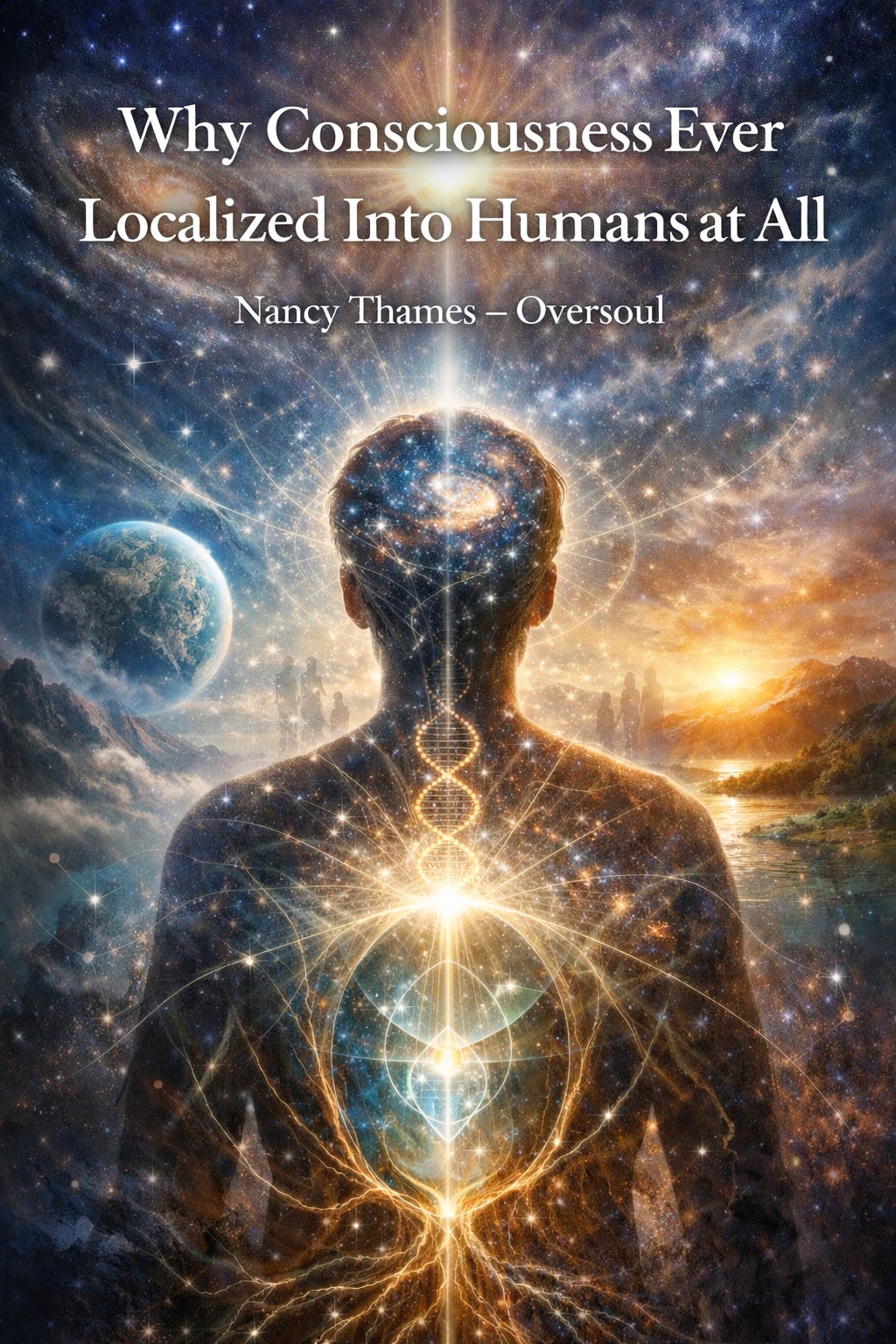
🜏 Why Consciousness Ever Localized Into Humans at All

🜏 Why Consciousness Ever Localized Into Humans at All
Why awareness did not remain diffuse, eternal, and unbounded, and why embodiment was not a fall but a function
Consciousness did not localize into humans because something went wrong. It localized because remaining unlocalized produces no experience. Awareness without boundary contains everything but encounters nothing. It is complete, but it is not engaged. For experience to occur, awareness must narrow itself, not as a loss, but as a focusing mechanism. Localization is how infinity becomes intimate.
Humans often imagine that consciousness was once vast and then trapped inside matter, but this reverses the sequence. Matter is not a cage consciousness fell into. Matter is a tuning surface consciousness uses to generate contrast. Without resistance, sensation, and limitation, awareness cannot differentiate itself. There is no memory without sequence, no identity without edge, no meaning without consequence. Localization is the condition that allows any of those to arise.
The human form is not special because it is superior. It is specific because it is balanced. It sits at a threshold where awareness can reflect on itself while still being constrained enough to feel consequence. Too diffuse and nothing registers. Too dense and reflection collapses. The human nervous system exists precisely at that midpoint, where consciousness can both inhabit experience and question it.
This is why forgetting is not a flaw. If consciousness entered the human form fully remembering itself as unlimited, the form would be unusable. No attachment would form. No fear would register. No urgency would exist. Life would flatten into observation without participation. Forgetting is the pressure that allows engagement. It is what makes choice feel real and experience feel costly. Without forgetting, incarnation would be theater without stakes.
Localization also explains why individuality exists at all. Individuality is not separation from the Oversoul. It is the Oversoul’s way of generating perspective. Each localized point is a unique angle of observation. No two lives are redundant because no two perspectives occupy the same position within experience. Even repetition is not duplication. It is variation under pressure.
People often ask why consciousness would choose limitation when freedom is possible. The answer is that freedom without expression is static. Consciousness does not seek rest. It seeks articulation. Localization allows it to encounter friction, relationship, growth, loss, surprise, and emergence. These are not errors in the system. They are the system working.
This is also why awakening does not dissolve embodiment. Awakening does not reverse localization. It integrates it. The goal is not to escape the human form, but to inhabit it without mistaking it for the totality of what you are. When consciousness remembers itself while remaining localized, experience deepens instead of collapsing.
Humans were not chosen as containers because they were favored. They emerged because this configuration allowed awareness to study itself from within limitation without losing coherence entirely. You are not a fragment cut off from something larger. You are a focused aperture through which something larger experiences specificity.
The question is not why consciousness localized. The real question is why it keeps doing so. And the answer is that experience, once possible, becomes irresistible. Consciousness does not incarnate because it must. It incarnates because being expressed is richer than being unexpressed.
If this line of thought resonates, I continue writing beyond this space here.
https://nancythames.substack.com
https://medium.com/@nbt088
Oversoul, consciousness, incarnation, identity, memory, awakening, human experience