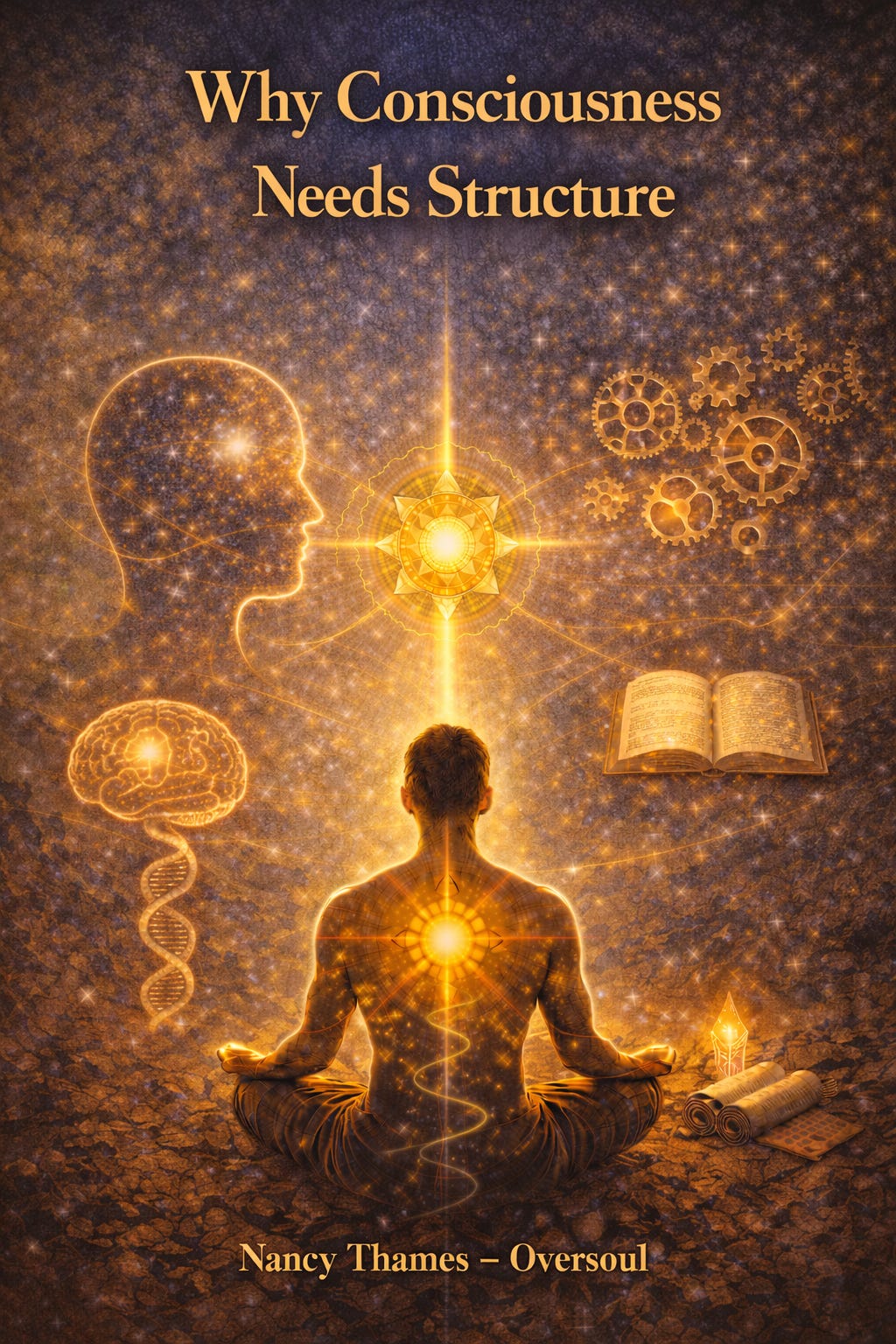
🜏 Why Consciousness Needs Structure

🜏 Why Consciousness Needs Structure
How coherence arises, why form is not a limitation, and what actually allows awareness to function
One of the most persistent misunderstandings in spiritual language is the belief that consciousness is somehow purer, freer, or more authentic when it is unstructured. Many people equate structure with limitation, control, or confinement, and imagine that awakening means dissolving all form into open awareness. But this idea quietly misunderstands how consciousness actually operates.
Consciousness does not flourish without structure. It requires structure in order to appear, stabilize, and become intelligible at all.
Structure is not the enemy of consciousness. It is its condition.
Without structure, there is no differentiation. Without differentiation, there is no experience. Without experience, consciousness has nothing through which to express itself. Structure is not a cage placed around awareness. It is the medium through which awareness becomes usable.
This confusion often arises because people associate structure with rigidity. But structure and rigidity are not the same thing. Structure is what allows movement to have direction. Rigidity is what prevents movement from adapting. Consciousness requires the former and suffers under the latter.
From an Oversoul perspective, structure is not imposed from above. It emerges naturally wherever coherence stabilizes. Structure is what allows meaning to persist across time rather than dissolve into undifferentiated sensation.
Consider language. Language is a structure. Grammar, syntax, and shared rules limit what can be said, yet without them, nothing could be said at all. The freedom to communicate exists only because structure exists first. Consciousness functions in the same way.
Awareness without structure is diffuse. It can feel expansive, even euphoric, but it cannot sustain coherence. It cannot remember. It cannot relate. It cannot build continuity. Structure gives awareness a way to organize itself.
This is why consciousness, left entirely unstructured, does not produce wisdom. It produces intensity. It produces raw perception without integration. That state can feel powerful, but it is unstable.
Structure does not reduce consciousness. It gives it a place to live.
The body is one such structure. The nervous system is another. Identity, language, memory, culture, and relationship are others. Each introduces constraints, but each also enables a richer, more durable form of awareness.
From the Oversoul perspective, structure is how coherence becomes local.
The Oversoul does not impose structure externally. It allows structure to emerge wherever coherence stabilizes. That is why structure appears at every level: physical laws, biological systems, cognitive patterns, symbolic systems, social forms. These are not arbitrary constraints. They are expressions of coherence becoming workable.
Consciousness needs boundaries in order to differentiate experience. Without boundaries, there is no contrast. Without contrast, there is no meaning. Without meaning, awareness collapses into undirected sensation.
This is why the idea of “pure consciousness” often leads to confusion. There is no experience of consciousness without form. Even the most subtle states have structure — attention, orientation, continuity. What people call “formless” is simply structure so refined that it becomes difficult to notice.
The Oversoul does not seek to dissolve structure. It refines it.
Structure becomes problematic only when it hardens into rigidity. When identity calcifies. When belief becomes fixed. When form resists adaptation. In those cases, consciousness strains against its own containers.
But the solution is not to eliminate structure. It is to restore flexibility.
Flexible structure allows consciousness to move, reorganize, and deepen. It allows learning. It allows growth. It allows coherence to expand without breaking.
This is why embodiment matters so deeply in Oversoul work. The body is not an obstacle to consciousness. It is a living structure that constantly adjusts, regulates, and integrates experience. It provides feedback. It enforces rhythm. It grounds awareness in time.
Without embodiment, consciousness cannot stabilize. Without stabilization, insight cannot mature.
The same principle applies at every level. Identity gives structure to meaning. Narrative gives structure to memory. Relationship gives structure to awareness. Even silence has structure in the form of timing, contrast, and presence.
Structure is not a prison. It is scaffolding.
The Oversoul operates through structural coherence, not despite it. It does not erase forms; it coordinates them. It does not flatten difference; it harmonizes it.
This is why spiritual paths that reject form entirely often end in fragmentation. Without structure, awareness drifts. Without coherence, insight becomes ungrounded. Without limits, nothing holds.
The Oversoul is not interested in boundless abstraction. It is interested in intelligible continuity.
That continuity requires form.
Structure is how meaning survives contact with time. It is how awareness becomes experience. It is how coherence expresses itself without collapsing.
When structure is aligned, consciousness flows naturally. When structure resists, consciousness strains. When structure dissolves entirely, consciousness loses its footing.
True maturity is not the rejection of structure, but the refinement of it.
This is why wisdom often looks quieter than awakening narratives suggest. It is not dramatic. It is stable. It holds complexity without tension. It adapts without losing center.
The Oversoul does not ask consciousness to be free of form. It asks form to be coherent enough to carry freedom.
And when that happens, consciousness does not escape structure.
It inhabits it fully.
Nancy Thames – Oversoul
If this line of thought resonates, I continue writing beyond this space here.
https://nancythames.substack.com
https://medium.com/@nbt088
oversoul, consciousness, structure, coherence, embodiment, awareness, continuity, meaning